


No society should excuse assassination. Murder affects levels of trust, impacts families, and influences freedom of expression. Condemnation stands firm without qualification. Analysis still matters because audiences now face a flood of claims that race past facts and reason.
#charliekirk
#Jesus
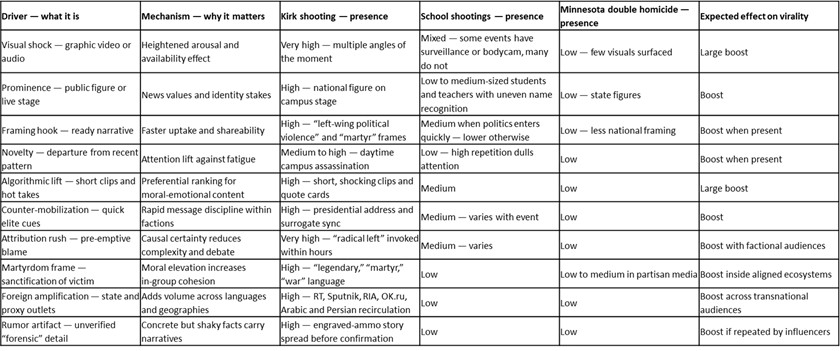
Recriminations and outrage surged after the Utah shooting for structural and psychological reasons that track with well‑studied effects. Graphic video raised emotional arousal and produced an availability spike, which made the event feel closer and more urgent than many prior killings that lacked visceral footage. A high‑profile political figure fell on camera in a public setting with a live audience, which met several classic news values at once—immediacy, prominence, conflict, drama. Algorithmic feeds favored short, shocking clips over longer context, which amplified one narrative frame within minutes and rewarded anger, fear, and moral judgment. That cocktail moved the event into a national fight over identity more quickly than most homicides or even many school shootings.
Comparisons with school shootings and the double homicide in Minnesota involve different salience profiles. Repeated school massacres generate terrible fatigue that reduces novelty and depresses attention relative to earlier episodes, which lowers viral lift unless new footage or unique facts appear. Private‑space killings that lack video or clear political framing receive far less national traction even when the facts shock the conscience. The Kirk shooting delivered a rare mix—celebrity status, daylight setting, multiple cameras, and an on‑stage debate context—which produced a larger outrage footprint than murders without those attributes.
Network dynamics converted those ingredients into sustained divisiveness. Moralized language tends to travel farther and faster than neutral language. Outrage posts accumulate social reward through likes and shares. Once such content takes off, motivated reasoning and identity‑protective cognition push groups to interpret new facts within partisan priors. Confirmation feeds confirmation. Opposing camps talk past each other and punish nuance because outrage feels righteous and performs well online. That cycle hardens attitudes while fresh details still emerge, which increases error rates and entrenches misperceptions.
Viral Spread and Unusual Outrage
Audience effects deserve clear text. Graphic footage steers attention and emotion. Identifiable victims and villains increase moral intensity. Outrage shortcuts deliberation and primes collective punishment narratives. Political entrepreneurs convert that energy into fundraising, list‑building, and turnout. Those mechanics explain why the Utah video produced a wider reaction than many equally tragic homicides that lacked a visual spark or a ready‑made storyline. None of that excuses uneven empathy. A republic functions when leaders condemn murder consistently across cases and resist the temptation to grade victims and crimes by partisan utility.
No society should excuse assassination. Murder erodes trust, chills debate and inflicts lasting harm on families and communities. Charlie Kirk’s killing demands clear moral condemnation without hedging. A free people solve disputes with words and ballots, never with bullets. Assassination has no place in a free nation — murder destroys families, chills speech, and poisons trust. Charlie Kirk’s killing warrants unqualified condemnation. Readers still need a clear record of what he said and what followed. The content below compresses verified statements, targets, audiences, and outcomes — then connect recurring themes to features scholars describe in fascist politics.
Evidence from the first twenty‑four hours shows an immediate blame narrative from Trump and prominent right‑wing media that framed the Utah killing as left‑wing political violence, despite investigators stating no confirmed motive or affiliation for the shooter in that window. Trump’s Oval Office address named the “radical left,” promised to hunt “each and every one” responsible, and set a message template that surrogates repeated across Fox News, Newsmax, and influencer channels using war metaphors and martyr language. Independent reporting documented that chorus and the speed of message discipline, while straight‑news outlets continued to note the absence of verified suspect links. Law enforcement updates focused on a manhunt, release of a person of interest, and recovery of a rifle, while cautioning against premature conclusions.
Performance grief parades across X, Facebook, Instagram, TikTok, and Truth Social insults victims and insults reason. Politicians, pundits, mothers, fathers, sons, and daughters who never lifted a finger against everyday gun carnage now wrap themselves in outrage and borrowed sanctimony. Cameras roll and they rush to center stage, not to seek answers, but to launder indifference with a trending clip. Silence reigned when children bled in classrooms and when families begged for basic guardrails—then sudden fury arrives when the spectacle flatters partisan identity. Hypocrisy glares—safety for children gets praised in a sentence and erased in the next vote.
Moral courage leaves receipts—hearings pushed, bills introduced, votes cast, constituents protected. Opportunists leave only hashtags and fundraising links. Public safety does not bend to vibes or viral reels—policy does the work. Families deserve leaders who speak before the camera arrives and stand firm after the camera leaves. Outrage without action equals complicity—pretend grief sells, real care saves lives.
Rumor lures amplified the outrage cycle. Several outlets reported a law‑enforcement bulletin describing ammunition with engravings referencing antifascist and transgender themes, yet federal officials had not confirmed that detail and some outlets flagged discrepancies across summaries. The result created a powerful framing hook for partisan blame before attribution. Use of that unverified claim grew across U.S. and overseas sites in multiple languages during the first news cycle.
Foreign information channels moved fast. Russian state media and large .ru social networks recirculated dramatic narratives, sometimes adding speculative or inaccurate elements such as asserted partisan identities for an alleged suspect, while Arabic and Persian outlets amplified graphic clips and emotive headlines. That multinational echo chamber helped push the “left did it” frame into non‑English feeds within hours.
Graphic video volume shaped the online environment. Platform reporting shows widespread circulation of close‑up clips across major networks, along with moderation advisories and policy updates. Research on virality shows that short, high‑arousal visuals paired with moral‑emotional language rise quickly in feeds, which matches observed spread patterns here.
Mainstream right outlets and movement institutions helped lock the narrative. Newsmax and Fox positioned Kirk as a martyr and emphasized a left‑wing threat environment. The Epoch Times and Heritage channels presented reverent obituaries and calls to national resolve, with Heritage’s president describing “martyrdom” as a turning point. OANN ran rolling items that corrected early custody rumors but kept the story at a boil.
Drivers of outrage across incidents
Sources underpinning updates include law‑enforcement briefings and mainstream coverage of the manhunt and platform responses, as well as documented rhetoric from Trump and right‑aligned media, plus foreign‑language recirculation.
Assessment of foreign bots and AI use
Open‑source checks across the first cycle show energetic state‑aligned amplification and rumor propagation in Russian outlets and large Russian‑language social networks, including claims about partisan identity and speculative “professional hit” narratives. Arabic and Persian feeds circulated graphic footage and emotive headlines. That cross‑border flow increases exposure to the same frames in new audiences and supplies English‑language outlets with foreign‑sourced talking points.
Comparative context for outrage and attention
Kirk’s killing produced a sharper outrage spike than most school shootings and the Minnesota double homicide of Democratic lawmakers in June 2025 for two structural reasons. First, visuals from the Utah campus hit feeds within minutes and sustained a rolling clip economy, while many school shootings lack equally graphic, platform‑permitted footage. Second, elite‑level cueing from the presidency and aligned media set a singular narrative within hours, while Minnesota’s case began with a manhunt and a local focus before the national press settled the facts. That asymmetry helps explain why the Kirk narrative flooded feeds more quickly and stayed higher for longer.
Escalation in rhetoric outran the facts in the first day, with a ready blame line and powerful images pulling audiences into hardened positions before investigators released confirmed findings. Foreign state media and large social platforms outside the U.S. added lift and, at times, inaccuracies that fed grievance and certainty. Responsible analysis requires two tracks at once — mourning a brazen killing while insisting on evidence for attribution. A careful, data‑based look at timing, phrasing, and network behavior will show whether the early “radical left did it” frame functioned as strategic diversion and whether coordinated inauthentic activity magnified that frame beyond genuine shock and grief.
Kirk and His Message – Synopsys over the years
In 2018, Charlie Kirk’s messaging increasingly zeroed in on culture wars, and he often found himself at the center of heated national debates. A tragic catalyst came on February 14, 2018: the Parkland high school shooting in Florida. In the aftermath, as student survivors called for gun control, Kirk arrived in Parkland to represent the other side. He spoke on behalf of the National Rifle Association (NRA) at a local event, amplifying his uncompromising support for the Second Amendment. Kirk argued that more guns, not fewer, would keep schools safe. “We should defend our schools like we defend banks or airports,” he declared, urging armed guards and metal detectors on campuses. He contended that “gun-free zones” invite killers and that arming trained staff could prevent the next massacre. A Parkland student even invited kirk to speak at Marjory Stoneman Douglas High itself. That appearance was ultimately canceled amid community outrage, but Kirk’s attempted visit drew widespread media coverage. It cast him as a leading voice of the pro-gun countermovement against teenage gun-control activists. On social media, he sparred directly with Parkland survivor-turned-activist David Hogg, accusing Hogg of “exploiting tragedy to erode fundamental rights.” The impact of Kirk’s stance was polarizing NRA supporters cheered his courage to confront a sensitive issue, while gun control advocates vilified him as out-of-touch. Undeterred, Kirk doubled down, invoking the Bill of Rights. “The Second Amendment is non-negotiable,” he tweeted that spring, “Our right to bear arms shall not be infringed[1] – even if Hollywood and the left throw a fit.” This absolutist approach to gun rights became a hallmark of Kirk’s platform.
2018 also saw Kirk entangled in controversy over misinformation. An avid Twitter user, he often fired off statistics and claims to bolster conservative narratives. In July 2018, Kirk tweeted a startling comparison to praise the Trump administration’s fight against crime: he claimed federal authorities had increased human trafficking arrests from about 1,900 in 2016 to over 6,000 in just the first half of 2018. The implication was clear – Trump’s team was cracking down hard on traffickers. However, this dramatic statistic was false, having originated on an internet conspiracy forum. When a fact-checker debunked it, Kirk quietly deleted the tweet the next day. Critics pounced, arguing that this incident showed Kirk’s careless relationship with facts and his willingness to spread unverified information if it suited his political aims. A few months later, in December 2018, Kirk repeated another unfounded claim: he told his audience (and tweeted) that protesters in France’s “Yellow Vests” movement were chanting “We want Trump!” in the streets of Paris. This too was quickly proven false – no such chant had occurred – and observers noted that President Trump himself echoed this erroneous talking point days later. These episodes tarnished Kirk’s credibility outside of his base. Mainstream media started to label him a “misinformation superspreader.” Still, inside the MAGA fold, Kirk faced little penalty. In fact, President Trump retweeted Kirk multiple times in 2018, and Kirk’s status as a trusted defender of the administration only grew. He learned to be more cautious by prefacing some claims with, “I hear that…” or “Some reports say…” but he never backed off the underlying tactic: aggressively pushing narratives that put the left on the defensive, even at risk of factual error.
By 2019, Charlie Kirk was a familiar name in American political discourse – and he continued to widen his influence. In July of that year, he took on a new role as chairman of Students for Trump, a grassroots group dedicated to President Trump’s reelection. Turning Point USA absorbed this organization into its structure (via an affiliate called Turning Point Action), signaling Kirk’s commitment to mobilize youth explicitly for partisan ends. He launched an ambitious initiative to recruit one million student voters for Trump’s 2020 campaign. Kirk traversed the country, holding “Students for Trump” rallies on campuses and urging young conservatives to register their classmates. He promised these crowds that “if Gen Z and Millennials turn out for Trump, we will shock the world again.” However, the drive fell short of its lofty goals, and after the 2020 election some in the Trump camp quietly blamed TPUSA for not delivering more of the youth vote. (For his part, Kirk bristled at such criticism, arguing that the GOP had “ignored young voters for too long” and that TPUSA was moving the needle, albeit gradually.)
1. While Kirk was working to broaden the right’s tent, he unexpectedly found himself under attack from an even more extreme faction on the right in late 2019. A group of white nationalist and ultraconservative agitators – nicknamed the “Groypers,” led by far-right internet personality Nick Fuentes – began infiltrating Kirk’s campus events. They viewed Kirk as insufficiently hardline, especially on issues like LGBTQ rights, immigration, and support for Israel. The tension came to a head on October 29, 2019, at Ohio State University, during Kirk’s “Culture War Tour” event. That night, Kirk sat on stage alongside TPUSA’s young, openly gay spokesperson Rob Smith. During audience Q&A, one of the far-right hecklers, Dave Reilly, seized the microphone and asked Kirk a shockingly crude question: “How does anal sex help us win the culture war?” The deliberately offensive query targeted gay conservatives like Smith in the movement. A hush fell as the crowd registered the slur. Kirk, visibly irked, responded sharply. He condemned the question’s homophobia and defended his decision to welcome all patriots. “We’re here to discuss ideas to save America – what people do in their bedrooms is not my business,” Kirk shot back in essence, making it clear he would not indulge bigoted distractions. He and Smith emphasized that one could be gay and a conservative, and that personal liberties extended to sexuality. The incident was widely publicized, highlighting a rift between Kirk’s TPUSA and the further right “America First” followers of Fuentes. The impact was twofold. Publicly, Kirk garnered praise in mainstream GOP circles for standing up to the hateful question – evidence of a somewhat inclusive conservatism. But privately, Kirk grew wary as these groyper disruptions continued at several tour stops. It was a bitter reminder that even as he fought the left on campus, he was flanked on the right by those who saw him as too moderate on social issues. Kirk later reflected that “there will always be fringe elements trying to divide our movement,” vowing that TPUSA would remain a big tent for anyone who loves America. Still, this episode nudged Kirk toward even more overt religiosity and social conservatism in his rhetoric, as he sought to appease portions of the base that distrusted any tolerance of LGBTQ individuals.
2. Gun rights continued to be a major focus. On April 5, 2023, Kirk spoke at an event hosted by TPUSA Faith at the Awaken Church in Salt Lake City, Utah – just days after a high-profile school shooting in Nashville – and sparked a new wave of outrage. Answering an audience question about gun violence, Kirk made an unusually candid admission. “You will never live in a society with an armed citizenry and have zero gun deaths,” he began, dismissing the idea of completely eliminating shootings. Then he delivered the line that would dominate headlines: “I think it’s worth it to have a cost of, unfortunately, some gun deaths every single year so that we can have the Second Amendment to protect our other God-given rights”. He argued this was the “prudent deal” Americans accept – just as car fatalities are accepted in exchange for the freedom of driving. Kirk’s blunt calculus – essentially that a certain number of murder victims each year was an acceptable price for gun liberty – was shocking to many. Media outlets from Newsweek to international papers published his quote as emblematic of America’s intractable gun debate. Democrats and gun-control advocates accused Kirk of valuing guns over children’s lives. But Kirk doubled down on his show, insisting he was simply being “realistic about trade-offs in a free society.” At the same event, he added that “having an armed citizenry comes with a price, and that’s part of liberty”, advocating again for armed guards at schools instead of any new gun laws. The target of these remarks was the broader American public wrestling with gun policy; Kirk wanted to harden his followers’ resolve that any concession on the Second Amendment was too high a cost. The impact was to pull the Overton window – the spectrum of acceptable discourse – a bit further toward absolutism on gun rights, aligning with the NRA’s most unyielding stance.
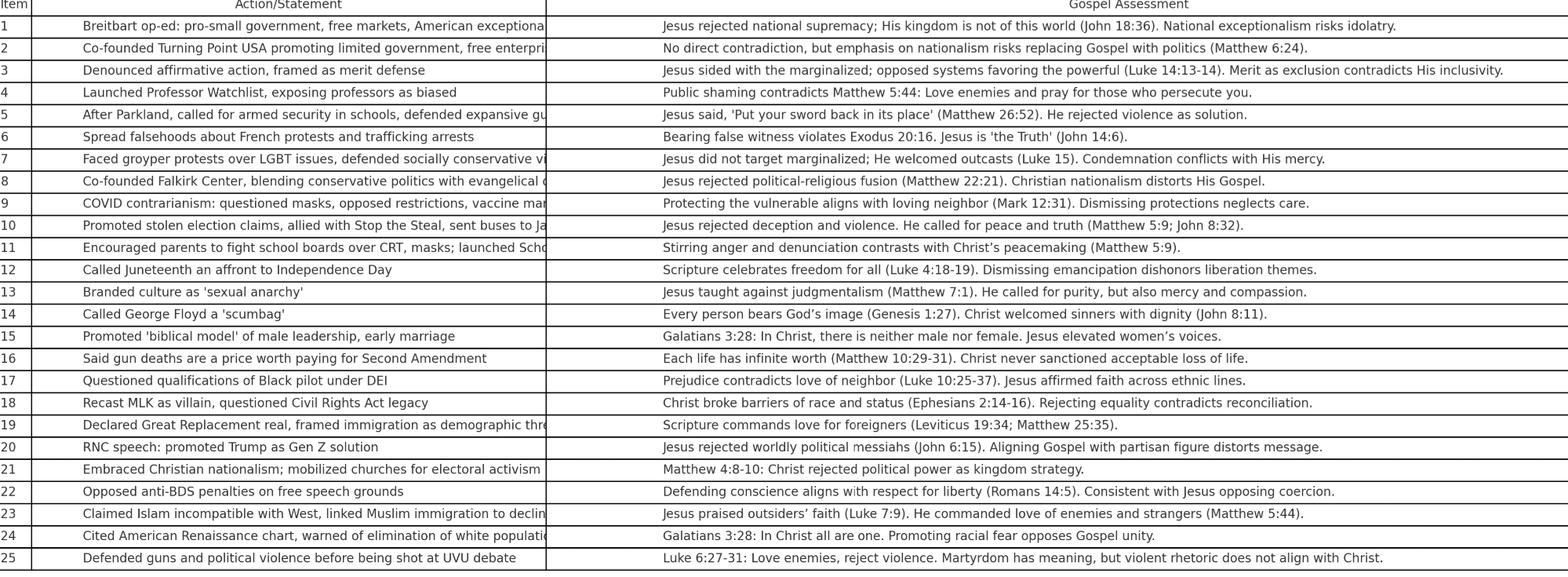
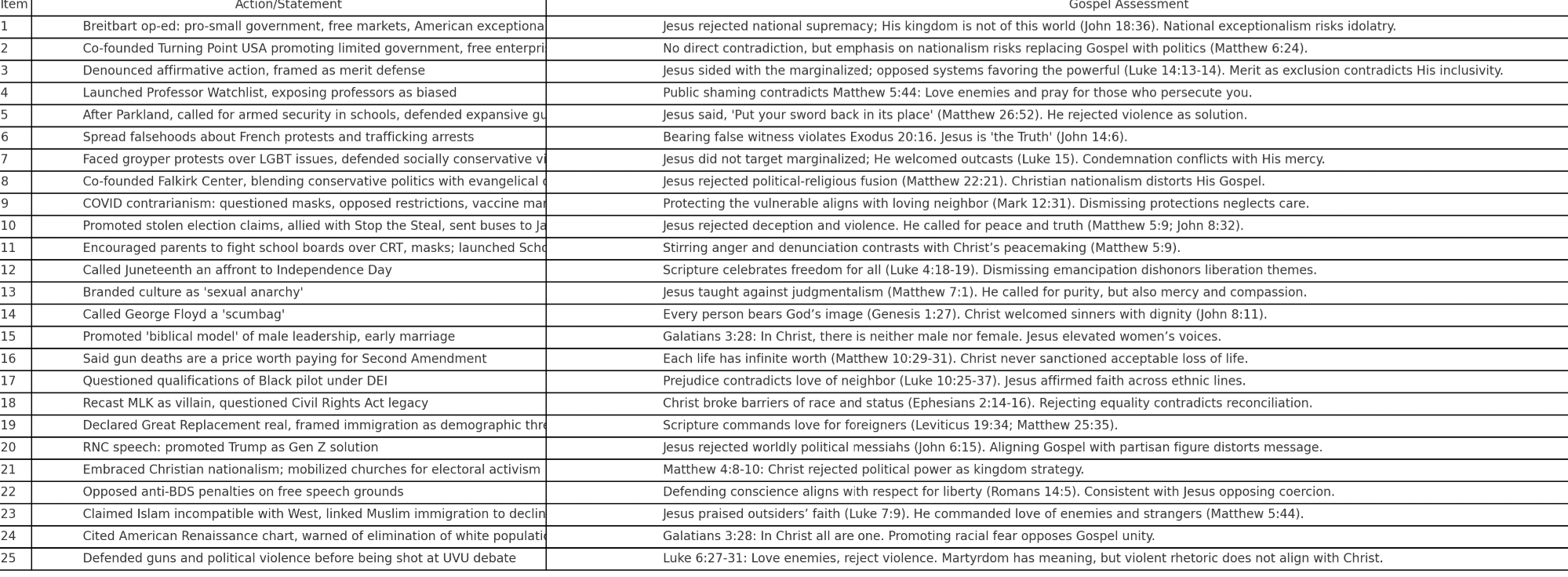
1. 2012 Apr 26 — Wrote a Breitbart op‑ed arguing that public‑school economics courses push left‑wing ideas and that students need instruction that favors small government, free markets, and American exceptionalism.
2. 2012 Jun 5 — Co‑founded Turning Point USA to promote limited government, free enterprise, and constitutional liberty on high‑school and college campuses.
3. 2015 Sep — Denounced affirmative action during a Silicon Valley talk and told a personal West Point story to frame opposition to race‑conscious admissions as a defense of merit.
4. 2016 Nov — Launched Professor Watchlist and argued that higher education indoctrinates students, calling for public exposure of professors he viewed as biased.
5. 2018 Feb–Mar — After the Parkland shooting, echoed NRA positions that schools need armed security and that gun‑free zones fail, aligning with expansive Second Amendment rights over new gun controls.
6. 2018 Nov–Dec — Shared viral falsehoods about French protesters chanting pro‑Trump slogans and about human‑trafficking arrests, using misinformation to bolster law‑and‑order and anti‑immigration narratives.
7. 2019 Nov — Faced “groyper” protests over LGBT inclusion at campus events and defended a pro‑Trump youth coalition while maintaining socially conservative views.
8. 2019 Nov — Co‑founded Liberty University’s Falkirk Center with Jerry Falwell Jr., blending conservative politics with evangelical outreach to pastors and students.
9. 2020 Apr–Jul — Pushed COVID contrarianism, questioned mask science, promoted hydroxychloroquine, cast church restrictions as anti‑Christian, and opposed vaccine mandates for students.
10. 2020 Nov–Jan 2021 — Promoted stolen‑election claims and allied with Stop the Steal organizers; boasted of sending “80+ buses” to Washington for Jan 6, while a Turning Point spokesman later put the figure at seven buses carrying roughly 350 people.
11. 2021 May–Sep — Urged parents to confront school boards over mask rules and critical race theory and backed a School Board Watchlist, expanding his parental‑rights and anti‑CRT focus beyond campuses.
12. 2021 Jun 17 — Called the federal Juneteenth holiday an ideological “affront” to Independence Day and warned against letting it supplant July 4.
13. 2021 Oct — Branded contemporary culture “sexual anarchy” on his show and then published an essay defending that line, tying social decline to loosening sexual norms and transgender inclusion.
14. 2021 Oct 5 — During an anti‑CRT tour stop in Mankato, Minnesota, called George Floyd a “scumbag,” linking his broader message to pro‑policing themes and opposition to BLM narratives.
15. 2022 Jun — Told Turning Point’s Young Women’s Leadership Summit that the “biblical model” favors men as protectors and leaders, promoting early marriage and family formation.
16. 2023 Apr 5 — Said some gun deaths are a price worth paying to preserve the Second Amendment, arguing that rights entail risk and that America should accept that tradeoff.
17. 2024 Jan — Claimed that seeing a Black pilot makes him question qualifications under DEI, turning opposition to DEI into a merit argument that targeted corporate and aviation hiring.
18. 2024 Jan–Mar — Recast Martin Luther King Jr. from past “hero” praise to “bad guy,” questioned the Civil Rights Act’s legacy, and sought to reset conservative memory of the civil‑rights era.
19. 2024 Mar — Declared that the “Great Replacement” is real and used it to frame immigration as demographic engineering, pressing for sharp immigration reductions.
20. 2024 Jul 15 — Used a prime‑time RNC speech to sell Trump (convicted felon and adjudicated rapist) as the solution for Gen Z’s economic stagnation and urged Republicans to “chase ballots,” marrying electioneering with a MAGA youth pitch.
21. 2024–2025 — Embraced Christian nationalism, argued liberty requires a Christian people, and used Turning Point Faith and “Freedom Night in America” to mobilize churches into electoral activism.
22. 2025 May 5–8 — Opposed a bipartisan expansion of federal anti‑BDS penalties on free‑speech grounds, saying government must not criminalize private boycotts.
23. 2025 Jun 2 — Said “Islam is not compatible with Western civilization” and linked increased Muslim immigration to social decline, advancing a restrictionism immigration position.
24. 2025 Aug 4 — Claimed Democrats seek to “eliminate the white population,” cited a demographic chart from the white‑nationalist site American Renaissance, and endorsed aggressive public‑order responses in Los Angeles.
25. 2025 Sep 10 — Addressed mass shootings and gun rights during a Utah Valley University debate when a sniper fatally shot him, turning his prior rhetoric on guns and political violence into a national flashpoint.
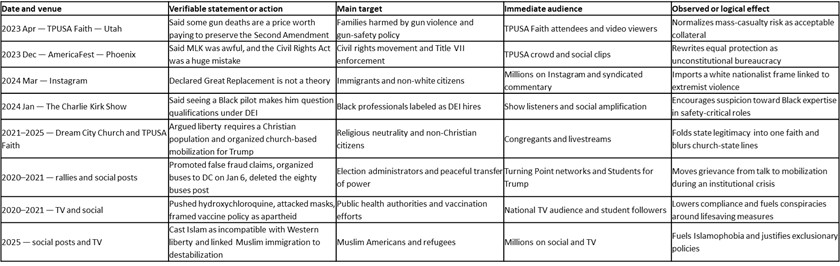
Statements – Targets – Effects
Drivers of Outrage
Positions – Effects

Charlie Kirk built a youth-focused propaganda enterprise that traded in racial grievance, Christian nationalism, and election denial. Evidence shows a pattern that maps onto features scholars associate with fascist politics—national rebirth stories, friend‑enemy binaries, scapegoating out‑groups, and contempt for liberal pluralism. Kirk’s words did not float in a vacuum. Quotes and on‑camera statements traveled through Turning Point stages, church pulpits, podcasts, and algorithmic feeds to millions. That pipeline rewarded shock, simplified law into slogans, and trained audiences to see fellow Americans as existential threats.
Evidence of extremist framing appears in black and white. Kirk posted that the Great Replacement is not a theory but a reality while tying immigration to demographic doom. That message matches a known white nationalist conspiracy with a record of inspiring violence from Christchurch to El Paso to Buffalo. Mainstream analysts and state investigations document that chain of influence. Kirk’s post did not invent the lie, yet he amplified it for a mass audience that trusted him.
Attacks on the Civil Rights Act and Martin Luther King Jr. reveal the project behind the provocation. Kirk told an AmericaFest crowd that MLK was awful and that passing the Civil Rights Act was a huge mistake because courts allegedly treat it as superior to the Constitution. That argument normalizes rolling back anti‑discrimination law while smearing a central figure in the struggle to enforce equal citizenship. The rhetoric fits a broader attempt to replace a neutral state with sectarian rule. Scholars describe that move as a hallmark of ultranationalist movements that promise a national rebirth at the expense of minority rights.
Christian nationalism sat at the center of his enterprise. Kirk moved from stating support for church‑state separation to preaching a fusion of “faith and freedom” at Dream City Church and telling audiences that liberty requires a Christian population. Turning Point built a standing rally inside a megachurch—Freedom Night in America—where partisan work blended with preaching and altar‑call politics. That fusion treats the First Amendment’s neutrality as a problem and recasts constitutional government as dependent on a single faith tradition. That frame invites state favoritism for one religion and suspicion toward religious minorities.
Racial resentment stayed in constant circulation. Kirk said on air that when he sees a Black pilot he hopes the pilot is qualified, claiming DEI corrupts standards. The line told followers to treat Black professionals as suspects and to treat diversity policy as a synonym for incompetence. That is textbook othering. Outrage in response did not come from a single camp; it crossed media ecosystems and forced damage control. The harm traveled far beyond one clip because the message fit a drumbeat that framed visible Black success as illegitimate.
Anti‑Muslim speech moved the same way. Posts tied Muslims to 9/11 and warned that Islam imports values that destabilize the nation. Kirk’s comparison of Muhammad to Jeffrey Epstein on British television piled on. Those statements push a civilizational siege story that treats millions of Muslim Americans as an alien bloc. Scholars of fascist propaganda describe that move as scapegoating a religious minority to mobilize the base. The result energizes harassment in the short term and normalizes policy discrimination over time.
Gun policy showed the same ethical posture. Kirk told a TPUSA Faith audience that some gun deaths are worth it to preserve the Second Amendment, after acknowledging that an armed citizenry means recurring fatalities. That position replaces prudence with sacrifice rhetoric where other families pay the price. The line sits near absolutist sloganeering that compresses the Second Amendment into four words—shall not be infringed—while ignoring constitutional structure, historical context, and the government’s interest in public safety upheld in case law.
Pandemic communication brought the pattern into public health. Kirk spread unproven cure claims, attacked masks, and called vaccine policies medical apartheid on national television. Platforms labeled and removed posts as misinformation. Students and congregants heard the same themes from Turning Point stages and church venues. That pipeline encouraged defiance of medical guidance, eroded trust, and raised risk for the most vulnerable.
Election denial and January 6 sit at the center of his legacy. Kirk amplified false fraud narratives after November 2020, organized buses to Washington, and deleted posts claiming eighty plus coaches when the riot made the cost visible. A participant charged with assault on officers arrived on a Turning Point bus. That chain shows how rhetorical permission slips move people from grievance to action. Language about civil war inboxes and a stolen country primes escalation against institutions that administer elections for everyone.
Statements — targets — effects

Founding documents in Kirk’s hands, what changed and how it landed. He turned the Constitution and the Bill of Rights into loyalty tests for his in‑group. The First Amendment lost its meaning as a shield for everyone once he declared that liberty requires a Christian people and treated anti‑discrimination law as a plot to silence conservatives. The Second Amendment turned from regulated liberty into a sacrament where preventable deaths became an acceptable price. The Declaration’s promise that all are created equal gave way to narratives that treat non‑white citizens, religious minorities, and LGBTQ Americans as threats to order. That is not defense of the founding settlement. That is a selective rewrite that narrows the circle of who counts as the people.
Reasons for the nastiness—propaganda incentives rather than accidental heat. Attention rewards transgression. Audience capture locks in escalation once influencers see which clips surge. Christian nationalist framing supplies a cosmic struggle that treats compromise as sin. Great Replacement and anti‑DEI narratives deliver simple villains. A stage crafted for confrontation—Prove Me Wrong tents, AmericaFest arenas, church shows—turns democratic argument into dominance displays. Scholars of fascist politics explain how that mix of ultranationalism, mythic rebirth, and scapegoating generates a politics that treats opponents as enemies to be punished, not neighbors to be persuaded. Kirk rode that logic from campus heckler‑baiting to a movement command post.
Kirk’s themes — fascism scholarship features — audience effects

Bottom‑line assessment. Kirk’s message harmed real people. LGBTQ youth heard that their care should be banned nationwide. Black pilots and Black professionals in every field heard a new reason to expect hostile doubt. Muslim Americans watched a leading figure tie their faith to terrorism and social decay. Voters heard that elections are rigged and that civil rights law subverts the Constitution. Followers learned to treat gun deaths as a price worth paying. None of that honors the founding promise. All that narrows who gets full membership in the republic. The record supports a blunt conclusion. Kirk forged a propaganda machine that mainstreamed extremist frames, trained audiences to see enemies at home, and left the civic fabric weaker and the public square meaner.
History offers a sober warning — those who set politics ablaze often stand closest to the flames when sparks fly back. A long campaign of incendiary framing forged loyal crowds and hardened foes, then left tinder across the public square. No grievance justifies murder, and no creed licenses a bullet, and yet dehumanizing rhetoric invites violent answers from the unhinged. A healthier republic needs fierce argument without contempt, courage without cruelty, and leaders who cool the temperature rather than raising it.
Recommendations
We sympathize with the Kirk family and reject performative condolences that drain urgency from prevention. Thoughts and prayers without policy feel hollow and, after years of avoidable carnage, dishonest. Public safety requires laws that reduce risk at the point of purchase, during possession, and at moments of personal crisis. A nation that honors rights with responsibility writes rules that keep weapons out of volatile hands and lowers the odds of political bloodshed.
Common‑sense legislation starts with universal background checks across every sale and transfer, with a single national query that includes felony and violent misdemeanor records, domestic violence orders, stalking convictions, and adjudications of dangerousness. Close private‑sale loopholes, require a ten‑day waiting period for all purchases, and mandate safe storage with child‑access prevention standards and random audit authority for cause. Enact a federal red flag law with due‑process guardrails—affidavit, rapid judicial review within seventy‑two hours, clear evidentiary thresholds, time‑limited orders, and guaranteed counsel—so families and law enforcement remove firearms from individuals who pose an imminent risk. Create a national requirement for annual safety classes and live‑fire proficiency tests tied to license renewal, with disqualification for failure. Set federal limits on concealed carry—higher training hours, stricter renewal intervals, sensitive‑place rules with real screening, reciprocity only to the highest standard rather than the lowest.
Ammunition policy deserves equal attention. Establish a federally issued ammunition purchaser card with a monthly cap, instant checks at point of sale, and reporting of threshold buys across retailers. Require lot‑level serialization and micro‑marking where feasible, plus mandatory reporting of lost or stolen ammunition and firearms within forty‑eight hours. Ban conversion devices and enforce a national cap on magazine capacity with a compensated buyback. Mandate liability insurance for civilian carriages outside the home so risk does not shift onto victims and taxpayers. Fund a national ballistics network and require test‑fire submissions from manufacturers for new models to speed tracing.
Several additional steps address political violence directly. Create a federal offense for armed intimidation in civic spaces—polling sites, legislative buildings, courthouses, election offices—with clear weapon‑free perimeters, magnetometers, and real penalties. Stand up a rapid restraining‑order mechanism for public figures and election workers who receive credible threats, paired with temporary purchase holds and immediate storage orders. Impose time‑bound rally safety plans for events above a set size—ingress controls, bag checks, and weapon bans—with a public‑risk bond posted by organizers that funds victim compensation when plans fail. Apply sentencing enhancements for crimes proven to have a political‑terror purpose.
Information friction helps break the feedback loop that turns spectacles into recruitment. Require large platforms to install default share‑delays for graphic violence, attach context cards from neutral sources within minutes, and label posts that call for retribution or vigilantism with downstream throttling and rapid review. Order independent audits of recommendation engines for violence amplification and mandate researcher access to data on virality of violent clips. Expand crisis‑driven ad moratoria that block fundraising tied to fresh bloodshed.
Prevention also moves through medical and community channels. Fund hospital‑based violence intervention teams and credible‑messenger programs in every county with mandatory data reporting and outcome evaluation. Expand extreme‑risk training for judges, school counselors, clergy, and primary‑care providers with a unified referral flow. Build a nationwide lost‑and‑stolen clearinghouse so local reports trigger serial‑number watchlists in real time. Offer tax credits for certified safes and smart‑storage devices and require secure‑storage compliance as a condition of any carry license.
Fresh ideas finish the package. Create an ammunition locker program at public ranges where bulk buyers store excess on site and draw down in tracked amounts. Pilot peace bonds for repeat threat‑makers—a refundable bond held by the court that forfeits upon credible new threats. Require a two‑step purchase confirmation for any buyer who posted violent threats within the prior ninety-day judge review plus reference checks—then lock purchases for thirty days after a denial. Tie instructor certification to student outcomes and revoke credentials for schools linked to negligent discharges or repeated safety failures. Fund a national victim compensation fund with a small excise on new firearm and ammunition sales so survivors receive timely support without charity theater.
A principled republic honors the Second Amendment while refusing the ritual of public mourning without reform. Sympathy for a grieving family rings true when paired with laws that cut risk, training that builds competence, and rules that separate weapons from rage. Moral seriousness asks for action that saves lives and lowers the temperature of politics. National character show up in statutes, not slogans.
References APA format
ABC News. (2025, September 11a). Graphic video of Kirk shooting was everywhere online, showing how media gatekeeper role has changed. https://abcnews.go.com/Business/wireStory/graphic-video-kirk-shooting-online-showing-media-gatekeeper-125464169
ABC News. (2025, September 11b). Manhunt for shooter continues after Charlie Kirk killed in Utah. https://abcnews.go.com/US/charlie-kirk-shot-event-utah-university-jd-vance/story?id=125451514
Al Jazeera. (2025, September 11a). Live — Charlie Kirk, Trump ally, shot and killed with manhunt under way. https://www.aljazeera.com/news/liveblog/2025/9/11/live-charlie-kirk-killing-stokes-fears-of-rise-in-political-assassinations
Al Jazeera. (2025, September 11b). Who was Charlie Kirk? What we know about the shooting and the suspect. https://www.aljazeera.com/news/2025/9/11/who-was-charlie-kirk-what-we-know-about-the-shooting-and-the-suspect
Al Jazeera. (2025, May 5). US bill to ban Israel boycotts faces right‑wing backlash over free speech. https://www.aljazeera.com
American Mind, The. (2021, October 14). On sexual anarchy. https://americanmind.org
Associated Press. (2025, September 11). Charlie Kirk, who helped build support for Trump among young people, dies after campus shooting. https://apnews.com/article/8357c3d102de09e3320fde761258131a
Bloomberg News. (2025, September 11). Epstein’s inbox — A trove of emails reveals Ghislaine Maxwell’s secrets. https://www.bloomberg.com/features/2025-jeffrey-epstein-emails-ghislaine-maxwell
Brady, W. J., Wills, J. A., Jost, J. T., Tucker, J. A., & Van Bavel, J. J. (2017). Emotion shapes the diffusion of moralized content in social networks. Proceedings of the National Academy of Sciences, 114(28), 7313–7318. https://doi.org/10.1073/pnas.1618923114
Business Insider. (2021, March 2). Man charged in Capitol riot took a bus paid by Turning Point USA. https://www.businessinsider.com/man-charged-capitol-riot-went-dc-bus-turning-point-usa-2021-3
CBS News. (2025, September 11). Charlie Kirk shot and killed at Utah event — Manhunt for shooter still ongoing. https://www.cbsnews.com/live-updates/charlie-kirk-shot-utah-turning-point-usa
Chicago Tribune. (2014, March 28). Wheeling grad rallies conservative youth. https://www.chicagotribune.com
Dream City Church. (2021). Liberty is God’s idea, not man’s idea — My speech at Dream City Church. The Charlie Kirk Show. https://thecharliekirkshow.com/podcasts/the-charlie-kirk-show/liberty-is-gods-idea-not-mans-idea-my-speech-at-dream-city-church
Financial Times. (2025, September 11). FBI releases images of “person of interest” in Charlie Kirk shooting. https://www.ft.com/content/3b6574ac-f8db-4998-9a91-e7f4bbe70a9b
Fox News. (2025, September 11). Charlie Kirk painted as “controversial,” “provocative” in media’s assassination coverage. https://www.foxnews.com/media/charlie-kirk-painted-controversial-provocative-medias-assassination-coverage
Future Hindsight. (2022, September 22). Fascism is all around us — Jason Stanley. https://www.futurehindsight.com/episodes/fascism-is-all-around-us-jason-stanley
Gerbner, G., Gross, L., Morgan, M., Signorielli, N., & Shanahan, J. (2002). Growing up with television — Cultivation processes. In J. Bryant & D. Zillmann (Eds.), Media effects — Advances in theory and research (pp. 43–67). Lawrence Erlbaum.
Guardian, The. (2016, November 22). Professors respond to conservative website listing “anti‑American” educators.
Guardian, The. (2022, May 17). What is great replacement theory and how did its racist roots take hold. https://www.theguardian.com/us-news/2022/may/17/great-replacement-theory-explainer
Guardian, The. (2025, September 11). “We are in a war” — Right‑wing media vow retribution for Charlie Kirk killing. https://www.theguardian.com/us-news/2025/sep/11/charlie-kirk-shooting-rightwing-media-reaction
Harcup, T., & O’Neill, D. (2017). What is news — News values revisited. Journalism Studies, 18(12), 1470–1488. https://doi.org/10.1080/1461670X.2016.1150193
Heritage Foundation. (2025, September 10). Heritage president mourns loss, condemns assassination of Charlie Kirk. https://www.heritage.org/press/heritage-president-mourns-loss-condemns-assassination-charlie-kirk
Hindustan Times. (2025, September 11). Charlie Kirk’s comments on Second Amendment and gun deaths resurface after UVU shooting. https://www.hindustantimes.com/world-news/us-news/charlie-kirks-comments-on-second-amendment-gun-deaths-resurface-after-uvu-shooting-101757535740663.html
Indian Express. (2025, September 11). Who was Charlie Kirk? Trump’s closest ally who once said, “Society should accept some gun deaths to protect rights.” https://indianexpress.com
Iowa Public Radio. (2024, October 29). Trump campaign turns to Turning Point USA to get out the vote. https://www.iowapublicradio.org/2024-10-29/here-now-trump-campaign-turns-to-turning-point-usa-to-get-out-the-vote
Jenni, K. E., & Loewenstein, G. (1997). Explaining the identifiable victim effect. Journal of Risk and Uncertainty, 14, 235–257. https://doi.org/10.1023/A:1007740225484
KATU/The National Desk. (2025, September 11). Trump vows to hunt down “radical‑left” after Charlie Kirk’s shocking assassination. https://katu.com/news/nation-world/trump-vows-to-hunt-down-radical-left-after-charlie-kirks-shocking-assassination
Los Angeles Times. (2025, September 11). Live updates — FBI releases photo of Charlie Kirk shooting suspect. https://www.latimes.com/politics/live/live-updates-charlie-kirk-conservative-activist-shot-killed-at-utah-university-event
Media Matters for America. (2025, August 4). Charlie Kirk pushes “great replacement,” targets Rep. Jasmine Crockett, and endorses aggressive public‑order responses. https://www.mediamatters.org
Mediaite. (2021, June 17). Charlie Kirk pummeled for calling Juneteenth an affront to Independence Day. https://www.mediaite.com
Minnesota Reformer. (2021, October 6). Right‑wing celeb Charlie Kirk thinks George Floyd is a “scumbag.” https://minnesotareformer.com
NDTV. (2025, September 11). Gun violence to “China virus” — Look at Charlie Kirk’s controversial takes. https://www.ndtv.com/world-news/charlie-kirk-assassination-gun-violence-to-china-virus-look-at-charlie-kirks-controversial-takes-9256666
New York Post. (2025, September 11). Gun recovered in Charlie Kirk assassination — Ammo bore pro‑trans, anti‑fascist messages. https://nypost.com/2025/09/11/us-news/gun-charlie-kirk-shot-with-revealed
Newsweek. (2023, April 6). Charlie Kirk says gun deaths are “worth it” to preserve the Second Amendment. https://www.newsweek.com/charlie-kirk-says-gun-deaths-worth-it-2nd-amendment-1793113
Newsweek. (2024, January 15). Charlie Kirk flips on Martin Luther King Jr., attacks growing “myth.” https://www.newsweek.com/charlie-kirk-flips-martin-luther-king-jr-attacks-growing-myth-1860839
Newsweek. (2024, January 24). Charlie Kirk’s Black pilot remark sparks fury. https://www.newsweek.com/charlie-kirk-black-pilots-racism-accusations-1863546
Noelle‑Neumann, E. (1974). The spiral of silence — A theory of public opinion. Journal of Communication, 24(2), 43–51. https://doi.org/10.1111/j.1460-2466.1974.tb00367.x
People Magazine. (2025, September 11). Person of interest in “political assassination” of Charlie Kirk released after interrogation. https://people.com/charlie-kirk-shooter-person-interest-custody-political-assassination-11807632
Political Research Associates. (2022, January 28). Ten years of Turning Point USA — From free markets to Freedom Square. https://politicalresearch.org/2022/01/28/ten-years-turning-point-usa
Politico. (2025, September 10). A new dark normal of political violence still shocks the nation. https://www.politico.com/news/2025/09/10/charlie-kirk-shooting-political-violence-america-00556694
Politico Florida. (2018, March 27). Parkland student rejected NRA invitation. https://www.politico.com
Reuters. (2020, February 3). Iowa official slams viral claim of suspicious voter registration activity as false. https://www.reuters.com/article/world/us-politics/iowa-official-slams-viral-claim-of-suspicious-voter-registration-activity-as-fal-idUSKBN1ZY03I
Reuters. (2025, September 11). Police search for sniper who killed conservative activist Charlie Kirk in Utah. https://www.reuters.com/world/us/police-search-sniper-who-killed-conservative-activist-charlie-kirk-utah-2025-09-11
Rev. (2024, July 15). Charlie Kirk speaks at RNC 2024 night one — Transcript. https://www.rev.com
RT. (2025, September 11). Conservative US activist Charlie Kirk shot. https://www.rt.com/news/624438-charlie-kirk-shot-utah
Snopes. (2025, September 10). Charlie Kirk once said some gun deaths worth it to have Second Amendment. https://www.snopes.com/fact-check/charlie-kirk-gun-deaths-quote
Sobieraj, S., & Berry, J. M. (2014). The outrage industry — Political opinion media and the new incivility. Oxford University Press.
Southern Poverty Law Center. (2023, May 12). Buffalo massacre — A year later, white supremacist propaganda continues to spur violence. https://www.splcenter.org/resources/stories/buffalo-massacre-year-later
Sputnik. (2025, September 11). Weapon used to assassinate Kirk recovered, identified as high‑powered bolt rifle. https://sputnikglobe.com/20250911/weapon-used-to-assassinate-kirk-recovered-identified-as-high-powered-bolt-rifle—fbi-1122770895.html
Sunstein, C. R. (2009). Going to extremes — How like minds unite and divide. Oxford University Press.
The Daily Beast. (2025, September 11). Charlie Kirk sniper’s ammo has “trans ideology and anti‑fascist” engravings — Cops. https://www.thedailybeast.com/charlie-kirk-snipers-ammo-has-trans-ideology-and-anti-fascist-engravings-cops
The New Yorker. (2017, December 21). A conservative nonprofit that seeks to transform college campuses. https://www.newyorker.com
The Verge. (2025, September 11). How platforms are responding to the Charlie Kirk shooting. https://www.theverge.com/news/776187/charlie-kirk-shooting-videos-platforms-meta-youtube
Tufekci, Z. (2017). Twitter and tear gas — The power and fragility of networked protest. Yale University Press.
Vanity Fair. (2021, July 8). Apartheid‑style, open‑air hostage situation — Conservatives lose their minds over Biden’s vaccination push. https://www.vanityfair.com/news/2021/07/charlie-kirk-republicans-vaccine-push
Vosoughi, S., Roy, D., & Aral, S. (2018). The spread of true and false news online. Science, 359(6380), 1146–1151. https://doi.org/10.1126/science.aap9559
Washington Post. (2025, September 10). Charlie Kirk — One of the right’s most prominent voices — Is fatally shot at Utah event. https://www.washingtonpost.com
Wikipedia. (2025). Palingenetic ultranationalism. https://en.wikipedia.org/wiki/Palingenetic_ultranationalism
Wired. (2016, July 20). At the Republican convention, Millennials search for signs of the future. https://www.wired.com
Wired. (2024, January 12). How Charlie Kirk plans to discredit Martin Luther King Jr. and the Civil Rights Act. https://www.wired.com/story/charlie-kirk-tpusa-mlk-civil-rights-act
Ynet News. (2025, September 11). Report — Pro‑transgender messages engraved on bullets. https://www.ynetnews.com/article/2f6v5w7rk
Yahoo News. (2024, June 12). Charlie Kirk once pushed a secular worldview — Now he is fighting to make America Christian again. https://www.yahoo.com/news/charlie-kirk-once-pushed-secular-110000108.html
[1] A well-regulated Militia, being necessary to the security of a free State, the right of the people to keep and bear Arms, shall not be infringed.


You must be logged in to post a comment.