


A Forensic Review of the R-Techno Report
Deconstructing a Manufactured Threat Narrative with Structured Intelligence Analysis
R-Techno’s student report on the Centre for the Fourth Industrial Revolution (C4IR) claims to be analytical output while operating as a disinformation delivery mechanism. The document follows a well-worn strategy–> inflate Western initiatives into instruments of imperialism, discredit international cooperation through guilt-by-association, and recycle ideological panic through historical distortion. Dissection reveals no intelligence methodology, no evidence-based reasoning, and no intellectual independence. The students are being manipulate to regurgitate the Kremlin line, not to critically think and analyze
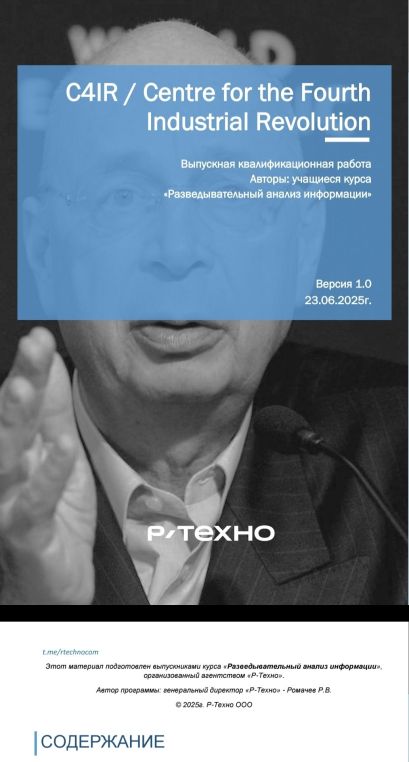
This material was prepared by graduates of the course “Intelligence Analysis of Information”, organized by the R-Techno agency.
Author of the program: General Director of R-Techno Romachev R.V.
20252. P-Techno LLC
| CONTENT
Key findings…
Basic information about the organization
History of the organization’s creation..
Key persons of the organization….
Klaus Martin Schwab
Jeremy Jurgens
Peter Brabeck-Letmathe.
Børge Brende
Richard Samans
Murat Sönmez
Stephan Mergenthaler
Organizational financing channels.
Initiatives implemented in the interests of commercial organizations
Projects for government agencies and special services…
The organization’s activities in (against) Russia and the CIS countries.
Activities in Russia..
Activities in Azerbaijan
Activities in Kazakhstan.
Activities in Ukraine.
Other famous projects of the company
Other information worth noting..
Private intelligence company “R-Techno”
https://r-techno.com
A proper analytic review demands structured breakdowns, adversarial modeling, cognitive bias recognition, and a separation of assumptions from verified facts. The report under review fails on every count. Emotional persuasion overrides methodical reasoning. Logical fallacies distort rather than reveal. Narrative framing replaces hypothesis testing. Propaganda masquerades as pedagogy.
Weaponized Education as Statecraft
Labeling the authors as “graduates” of an “intelligence analysis” course under Romachev’s R-Techno disguises the intent behind the exercise. Education ceases when indoctrination begins. Romachev—an ex-FSB operator turned Kremlin-aligned strategist—has constructed a pipeline for manufacturing ideological technicians. Their task lies not in discovery but reinforcement. The C4IR report reveals a pattern of trained mimicry, not trained analysis. Repetition replaces exploration. Preconception drives output.
Formal indicators of structured analytic tradecraft never materialize. No source vetting framework. No probabilistic reasoning. No source crediblity or relevance validation. No use of structured techniques, SWOT, or Red Teaming. The writers offer a cascade of declarative conclusions without separating raw data from inference. That pattern matches known Russian disinformation templates, particularly those embedded within academic institutions co-opted for state narrative dissemination.
Psychological Framing Through Reductive Language
Early pages shape the perception of C4IR through emotionally loaded phrasing and historical guilt projection. Klaus Schwab appears not as a son of a Nazi-linked industrialist allegedly involved in nuclear experimentation. The biographical smear relies on genetic fallacy—a technique favored in Russian psychological operations to reframe technocratic leaders as ideological threats. No verified connection exists between Schwab’s institutional efforts and his father’s wartime activities. Presenting such lineage as causality introduces historical contamination without substantiating motive or continuity.
Narrative saturation functions as an obfuscation tactic. Readers drown in named actors, initiatives, and dates without comparative context or relevance hierarchies. Klaus Schwab, Jeremy Jurgens, and Murat Sönmez appear alongside extended family references and corporate donors, creating an illusion of exhaustive evidence. Exhaustion replaces clarity. Ambiguity fosters distrust. That is the goal.
False Binaries and Moral Absolutism
Opposition appears binary. Either adopt “technological sovereignty” under Moscow’s paternal gaze, or submit to globalist subjugation through C4IR-backed partnerships. No allowance exists for hybrid development models. No differentiation appears between open-source innovation and proprietary control. Every collaboration becomes evidence of espionage. Every foreign grant transforms into a hostile insertion. That rigid dichotomy distorts the structure of global scientific cooperation.
Fallacious reasoning anchors those arguments. Slippery slope projections claim that blockchain standards enforced through C4IR will result in financial surveillance targeting Russian state actors. The conclusion presumes intent without demonstrating design. Causation is inferred from correlation. No technical documentation or protocol-level analysis appears. No blockchain standard under C4IR mandates state-targeted financial discrimination. The narrative inflates possibility into inevitability.
Intellectual Sabotage Disguised as Sovereignty Defense
Repeated references to “technological sovereignty” function as ideological camouflage. The Russian state narrative depends on the illusion of innovation blockade. That illusion justifies technological isolation, import substitution, and central control over data ecosystems. Real stagnation inside Russia’s innovation sector results from corruption, intellectual exodus, and elite capture—not foreign interference. The report distorts cause and projects blame outward as they become victimhood indoctrinated.
A genuine intelligence report would compare C4IR’s engagement model across regions. India’s involvement with C4IR includes data ethics consultations and AI transparency pilots. Rwanda’s C4IR hub drives smart agriculture systems. Japan, South Korea, and Germany participate in blockchain regulation workshops. The claim that C4IR operates as a CIA proxy collapses when examined through comparative analysis. No single governance model or political allegiance defines the initiative. Participation varies by national intent.
Disinformation Signatures and Operational Purpose
Every paragraph reflects a calculated design. Narrative consistency, not factual inquiry, drives the structure. The document exhibits standard features of a Kremlin-aligned information operation:
- Implied consensus–>Phrases such as “according to researchers” or “many experts believe” appear without named citations or peer-reviewed sourcing. Fabricated consensus constructs artificial authority.
- Flooding zone with actors–> Pages list corporate partners, state actors, NGOs, and think tanks without establishing causality or influence. Proximity becomes guilt.
- Projection–>Accusations of surveillance, coercion, and manipulation mirror Russia’s documented practices. Foreign efforts become a mirror image of domestic ones—reframed as threats to sovereignty.
- Manufactured crisis–>The report paints C4IR involvement as existential. No allowance appears for disengagement, negotiation, or sovereignty-preserving partnerships. Only capitulation or isolation.
Strategic Outcome and Intended Consumption
Target audiences for the document include Russian policymakers, security elites, and peripheral states hesitant to engage Western tech standards. Secondary targets include technocratic students within Russia and the CIS bloc, where exposure to international frameworks threatens ideological loyalty. Tertiary targets include global critics of WEF, who unknowingly amplify Kremlin narratives when reacting to C4IR through conspiracy rhetoric.
The report’s design reflects a hybrid warfare posture. Academic publishing becomes theater. Students become mouthpieces. Research becomes weapon. Clausewitz envisioned war by other means. Romachev teaches it with Microsoft Word and a Telegram channel.
Manufactured Intelligence, Synthetic Threats
No analytic rigor exists within the R-Techno C4IR report. Every conclusion arrives prewritten. Every line functions as a delivery mechanism for institutional distrust and geopolitical paranoia. No curiosity fuels the investigation. Obedience does.
Western initiatives in governance technology, AI ethics, and blockchain interoperability pose challenges. Those challenges deserve informed debate. That debate cannot happen through manufactured hysteria. No sovereign innovation emerges from scripted resentment. No national advancement follows from intellectual submission.
C4IR represents one institutional approach to cooperative science policy. That does not make it perfect. It also does not make it an empire. Those trained to see only enemies have been taught to remain blind. Just like all the past reports of this type, the ending is always the same.
Disinformation does not always shout. Sometimes, it publishes.


You must be logged in to post a comment.