
Which suspicious cases should we report to security agencies?
If you see a pickup truck, truck, or trailer of all types with two or three passengers entering a rented villa or gardens, industrial units, etc.
If you hear the sound of a quadcopter flying around your residence.
If you see one or more people filming around a military-industrial zone or even institutional residential areas.
If you see a pickup truck of any type or truck go off the road and head towards off-road tracks.
If you saw, all the passengers in a pickup truck were wearing masks and goggles.
If you see a person or people flying a quadcopter anywhere, even in seemingly ordinary places.
If you see vehicles, whether cars or vans, carrying large Samsonite-like bags.
In order to maintain the security of the country and protect the lives of our dear compatriots, please take the above matters seriously and call 113 and 114 immediately and without hesitation.
Barna news agency
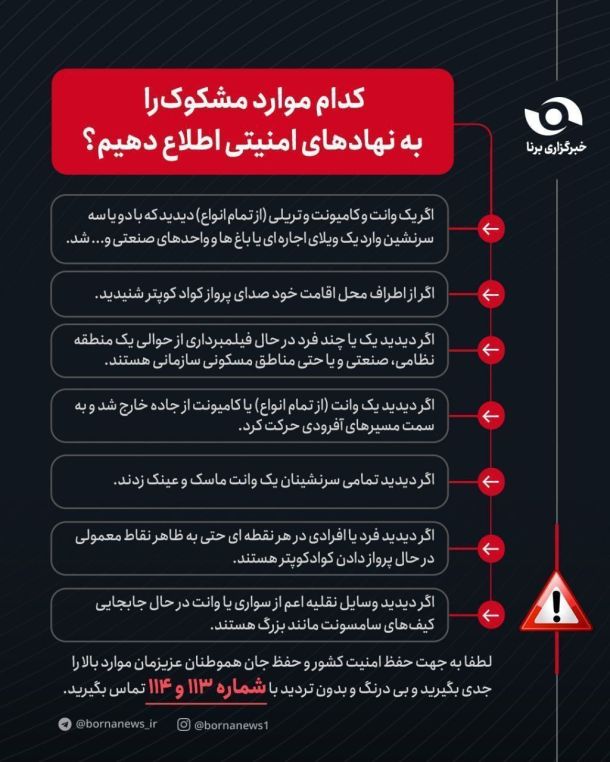
The Bornanews infographic in question is authentic and part of a broader official advisory issued by Iranian security agencies. Multiple state-linked media outlets in Iran – from news agencies to newspapers – have published the same guidance, confirming its legitimacy and timing.
For example, Hamshahri (a major Iranian daily) reported the Ministry of Intelligence’s bulletin listing specific suspicious activities citizens should watch for and report. These include scenarios such as: “If you see a pickup truck, van or trailer with 2–3 occupants entering a rented villa, garden or industrial unit… If you hear the sound of a quadcopter drone near your residence… If you see one or more individuals filming around a military, industrial, or even residential compound… If all the passengers of a pickup truck are wearing masks and goggles…”, among other warnings. The consistency of this message across Iranian outlets (Hamshahri, IRNA, Nour News, etc.) verifies that the infographic’s content is genuine and was disseminated as an official public advisory. Timing-wise, it coincided with a period of heightened security alerts in Iran – mid-June 2025 – when Iranian authorities were responding to what they described as new sabotage threats from Israel. Bornanews, a state-affiliated news agency focusing on youth, amplified the message in infographic form around that time, aligning with identical notices on state TV and other news platforms. In summary, the infographic is not a fabrication; it reflects a real campaign launched by Iran’s security apparatus during a sensitive security juncture.
Origin
This public advisory originated from an official Ministry of Intelligence (MOIS) communiqué, issued amid escalating concerns about espionage and sabotage activity inside Iran. The immediate context was a surge in security “sensitivity” due to threats attributed to Israeli intelligence (Mossad) operations. Iranian outlets report that MOIS released a formal “important announcement” calling on citizens to help safeguard the country given the “sensitive security conditions” following hostile actions by the “Zionist regime”. In fact, Iranian and international sources tie the timing directly to recent incidents: Israeli covert teams had been accused of smuggling small drones into Iran and using vehicles like pickup trucks as launch platforms for attacks on Iranian facilities. Shortly after such a drone-based sabotage operation was exposed, the Ministry of Intelligence publicly urged heightened vigilance. Thus, the infographic’s content originates from this MOIS warning, which appears to be part of a counter-intelligence/counter-sabotage campaign. The language used (“security of the country is not possible without the cooperation of you, the people”) underscores that it was an official, state-sanctioned message enlisting public cooperation. Notably, the Islamic Revolutionary Guard Corps (IRGC) and other agencies echoed the call, indicating a coordinated origin. For example, IRGC’s own outlets (Sepah News) announced that “in light of the enemy’s insane act of sabotage,” any suspicious movement should immediately be reported to their tip lines as well. In summary, the advisory originated from Iran’s security establishment (spearheaded by MOIS, with IRGC input) as a proactive measure against perceived Israeli spy/sabotage plots. The Bornanews infographic is essentially a repackaging of that official MOIS bulletin for public consumption.
Agency Involvement
Multiple Iranian security and intelligence agencies are explicitly tied to this message. The Ministry of Intelligence (MOIS), which issued the initial warning, is front and center – it asked citizens to contact its 113 hotline (known as “Setad Khabari 113”) with any reports. The IRGC’s Intelligence Organization is also directly involved, urging reports via its own 114 tip number. In fact, IRGC statements were released in parallel: IRNA news agency relayed that *“IRGC Intelligence has asked the zealous people of Islamic Iran to immediately send any news of suspicious movement or incident to the IRGC and Basij news center at number 114.”*. This shows IRGC and its Basij militia (the volunteer paramilitary network) are formally part of the campaign, using the same 114 hotline. Iran’s law enforcement and military security units are likewise integrated. The advisory lists FARAJA (Iran’s police force, formerly NAJA) through the 116 number for the Police Intelligence Organization. It also includes the Ministry of Defense’s protective intelligence unit via number 1636, and even the IRGC’s own internal security branch via number 1535. Additionally, the standard police emergency/reporting line 110 is mentioned as a public reporting channel in some versions of the notice. In effect, all major Iranian security organs – MOIS, IRGC Intelligence, the national police intelligence, and military counter-intelligence units – are jointly involved. This unified front suggests the infographic is part of a national counter-intelligence effort, not just a media gimmick. Each agency’s contact is provided so citizens can route information to the appropriate service. The inter-agency nature of this message underlines that it’s officially sanctioned at high levels (likely coordinated via Iran’s Supreme National Security Council), aiming to enlist the public across all jurisdictions.
Distribution Channels
The campaign has been distributed widely across state media, official websites, and social platforms, ensuring maximum reach. Traditional media: Iranian state television (IRIB) broadcast the security warnings as news alerts, and state-run news agencies (like IRNA, Fars, Tasnim, Mehr) published articles and even infographics. For instance, IRIB’s news site carried a detailed security awareness bulletin from MOIS, explaining the need for public vigilance and listing the tip numbers to contact. Major newspapers and online outlets repeated the advisory; Hamshahri Online and Farhikhtegan Daily ran pieces on reporting suspicious vehicles and activities. Bornanews itself – being a semi-official news agency – not only published the text but also created a sharable infographic summarizing the key points (drone sightings, strange truck activity, etc.), which circulated on social media and messaging apps. On Telegram channels and Iranian social networks (like Aparat, Cloob, as well as Instagram Threads and others), the same content appeared, often with the tagline: “امنیت کشور بدون همکاری شما مردم میسر نیست” – *“National security is not possible without the cooperation of you, the people.”*. Users on Instagram and Threads shared the list of hotline numbers for MOIS, IRGC, police, etc., alongside the exhortation to report any “تحرکات مشکوک” (suspicious movements). Even provincial authorities pushed the message: in Fars province, the local Crisis Management headquarters reminded citizens to report unusual packages or the movement of unfamiliar refrigerated trucks via the 113, 114, 116 lines, etc.. This multi-channel dissemination – from state TV and news sites to Telegram and regional announcements – demonstrates that the campaign was an organized information drive. The consistency of the content across platforms indicates top-down direction. The infographic’s distribution through Bornanews and others was likely intended to make the advisory visually engaging and easily reposted by the public. In summary, the message permeated official media and Iranian cyberspace, reflecting a broad government public outreach effort in counter-intelligence.
Operational Goals
Operationally, this initiative serves as a counter-intelligence and counter-sabotage measure. The primary goal is to leverage the public as eyes and ears to detect and foil possible terrorist or espionage operations – essentially crowd-sourcing homeland security. By enumerating specific suspicious behaviors (e.g. covert drone flights, masked operatives, off-road vehicles near sensitive sites), the agencies are directing citizens to scenarios typical of clandestine operations, likely informed by recent threat intelligence. The Ministry of Intelligence explicitly noted the “possibility of enemy-affiliated saboteurs using light cargo vehicles like pickups to transport micro-drones, equipment, or personnel” and warned that unusual stops or cargo in such vehicles near sensitive facilities should be treated as suspect. This indicates a clear counter-sabotage focus: Iran had uncovered tactics like drones launched from trucks and safe-houses used by Mossad cells, and now aims to preempt them by enlisting citizen reporting. Indeed, the advisory came on the heels of arrests of alleged Israeli agents and discovery of drone smuggling operations. (E.g., Iranian forces recently seized a van carrying Israeli-made quadcopter drones inside Iran, and busted a Mossad safe-house in Alborz where operatives were building bombs.) By rapidly publicizing what to look out for, the intelligence agencies hope to intercept such plots before they materialize. Another operational objective is deterrence: publicizing that everyone is watching may deter adversaries or local collaborators from attempting sabotage, knowing an ordinary person could report them. The campaign also helps streamline reporting: by advertising the 113 and 114 hotlines (and others), the agencies encourage a centralized flow of tips, enabling faster response. This aligns with longstanding Iranian security doctrine that views public mobilization as crucial for comprehensive defense – harking back to the wartime slogan “each citizen a soldier.” In essence, the operational intent is to bolster Iran’s counter-terror/counter-espionage shield through civic engagement, increasing the chances of detecting foreign plots (such as Mossad-led sabotage or assassination attempts) in time to neutralize them. If successful, this collective vigilance should augment the reach of Iran’s formal security forces, creating a more inhospitable environment for Israel’s clandestine operations on Iranian soil.
Psychological Impact
Beyond its immediate security aims, the call to public vigilance carries significant psychological and social effects. Domestically, it serves to heighten the sense of external threat and rally citizens around national security, which can fortify public solidarity (or at least compliance) in tense times. By constantly reminding people of “hostile enemy plots” and urging them to be on guard, the state cultivates a siege mentality that can legitimize a stronger security presence and stricter measures. This can be seen as a form of psychological operations (PSYOP)–> keeping the public mentally prepared for danger and encouraging an atmosphere of alertness (and even mild paranoia) about lurking saboteurs. On one hand, it reinforces a patriotic narrative – that ordinary Iranians have a duty to protect their homeland by reporting anything amiss, effectively deputizing the populace. Iranian officials explicitly frame this as a positive civic duty; for example, the MOIS advisory noted that in Western countries citizens routinely inform authorities of suspicious activities and that such “security culture” is a hallmark of developed societies. This messaging is designed to normalize informant behavior and present it as a patriotic contribution to “sustainable security.” On the other hand, the campaign can also instill fear and suspicion at the societal level. Neighbors may view unfamiliar persons or benign activities with increased distrust, knowing the government is encouraging reports of anything unusual. In a society already under heavy surveillance, this amplifies the social monitoring effect – people may self-censor or avoid behaviors that could be misconstrued as “suspicious” (such as photographing infrastructure or flying hobbyist drones). There is also a potential chilling effect on dissent: a population primed to report strange behavior might just as easily report on political protesters or regime critics, whether intentionally or due to overzealous interpretation of “unusual activities.” In that sense, while the stated aim is counter-terrorism, the psychological impact serves the state’s broader interest in control by fostering a culture of vigilance (and informing) that blurs the line between genuine security threats and domestic opposition. However, it should be noted that in the current context – following Israeli covert attacks and the arrest of Mossad operatives – the public vigilance campaign genuinely resonates as a defensive reaction. It likely boosts morale among security forces and regime loyalists by demonstrating that Iran is proactively responding to Mossad’s intrusions. For the general public, the campaign’s impact is twofold: it reassures them that they can play a role in protecting their communities (empowering loyal citizens), while also subtly warning them that the security organs are omnipresent (potentially dissuading anyone who might be aiding the enemy or even contemplating anti-regime activities). In summary, the psychological operation at play reinforces a narrative of unity against foreign enemies and integrates the public into the surveillance apparatus – bolstering both Iran’s counter-intelligence posture and the regime’s internal stability through heightened alertness.
Sources: Official Iranian media (Hamshahri, IRNA, Tasnim) carrying the Ministry of Intelligence statement; Nournews and local news reiterations of the public reporting campaign; IRGC’s parallel announcement via Sepah News (as quoted by IRNA) stressing reports to 114; analysis by external observers linking the advisory to recent Israeli sabotage and spy arrests; and translations of Persian content by the assistant.

You must be logged in to post a comment.