


The group known as “عدالت علی” (Justice of Ali) frames its exposé on “ستاد الغدیر” (Setad Al-Ghadir or Al-Ghadir Headquarters) as part of a broader narrative of resistance against what it terms an authoritarian and exploitative regime in Iran. Their language and symbolism suggest a deliberate attempt to mobilize public opinion through a combination of accusatory rhetoric, structured intelligence leaks, and strategic media framing.
Narrative Strategy and Ideological Framing
Justice of Ali deploys metaphor-rich, emotionally charged language to accuse Al-Ghadir Headquarters of being not merely a bureaucratic institution but a calculated node in a systemic apparatus of repression and corruption. Phrases like “germ of corruption,” “suck our blood,” and “dark cells” construct an image of a parasitic and clandestine state entity. These terms invoke a dual meaning—simultaneously referencing biological contagion and secret imprisonment—tapping into deep societal fears about both physical decay and authoritarian control.
Their claim that Al-Ghadir was established to combat an “imaginary enemy” functions rhetorically to delegitimize the state’s narrative of external threats, instead implying that the real objective is internal surveillance and coercion. This aligns with historical patterns seen in Iranian governance where national security justifications have often been repurposed to stifle dissent, especially through organizations like the Basij and IRGC’s Intelligence Organization.
Organizational Structure and Intelligence Implications
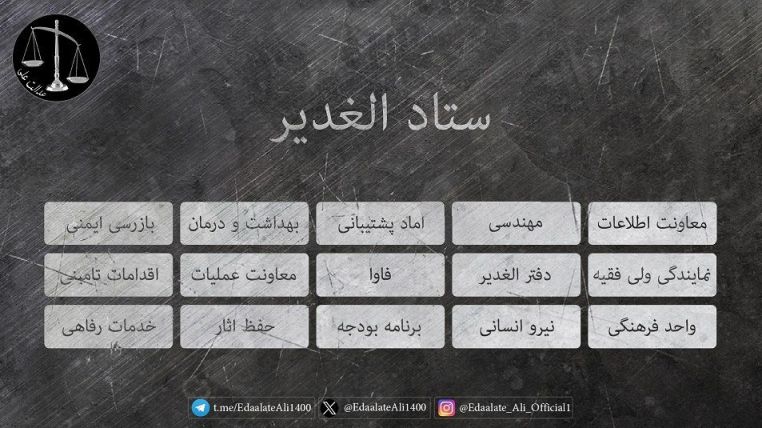
The diagram accompanying the post lays out a detailed organizational structure for Al-Ghadir Headquarters. Departments such as معاونت اطلاعات (Intelligence), معاونت عملیات (Operations), فاوا (ICT), and نمایندگی ولی فقیه (Representative of the Supreme Leader) point to an institution deeply embedded within Iran’s theocratic-security complex. The inclusion of both civilian service (Health, Welfare) and hard security functions (Operations, Intelligence, Security Measures) suggests a hybrid entity capable of conducting surveillance, ideological indoctrination, and logistical operations under the guise of governance.
This format mirrors known IRGC-affiliated organizational models where overlap between military, religious, and administrative roles serves to consolidate control and inhibit accountability.
Tactical Analysis and Methodology
Justice of Ali’s assertion that they “spent a lot of time categorizing and drawing this structure” implies a multi-source intelligence effort, likely relying on whistleblowers, intercepted communications, or data breaches. The statement “Keep sending information” confirms an open-source HUMINT model, inviting insider collaboration—common in decentralized opposition networks. This tactic reflects broader resistance models observed in Iranian digital dissent spaces, such as guerrilla broadcasting and distributed whistleblowing platforms.
Strategic Messaging and Socio-Political Impact
By portraying Al-Ghadir HQ as both omnipresent and secretive, Justice of Ali attempts to delegitimize the notion of state-provided stability and replace it with an image of omnipotent corruption. Their choice of the name “Justice of Ali” evokes Shiite iconography of divine justice and righteous struggle, framing their operations not as subversive, but as a moral rectification. This rhetorical appropriation positions them in contrast with the regime’s own Shiite legitimacy claims.
The group’s strategy appears to mirror broader Iranian activist and cyber-opposition tactics where high-value leaks are paired with polished media dissemination to maintain narrative control and public attention. This methodology also resembles tactics used in past exposures of IRGC cyber units and covert front companies.
Conclusion and Geopolitical Context
The Justice of Ali group is not merely making ideological statements—they are executing a coordinated information operation. Their exposé of Al-Ghadir HQ, framed through visualized intelligence and symbolic rhetoric, is a methodologically sound attempt to undermine state legitimacy, solicit insider leaks, and present themselves as a legitimate counter-state intelligence body. Given the history of Iran’s hybridized military-civil institutions, such revelations, if credible, represent a significant challenge to the state’s monopolization of narrative and power.
The operation should be seen in the context of Iran’s broader internal dissent dynamics, the weaponization of bureaucracy, and digital insurgency tactics that mirror the playbooks of other opposition-aligned cyber groups like Black Reward and Edalat-e Ali. Their evolution from symbolic protest to actionable intelligence sharing highlights an escalating front in Iran’s information warfare theater.



You must be logged in to post a comment.