


The Rutube video titled “Пушки гремели, но исход войны решали радиопомехи и перфоленты” (translated as “Cannons roared, but the outcome of the war was decided by radio jamming and punched tape”) presents a stylized and misleading revision of World War II history. Released around Victory Day (May 9), the video blends nostalgic commemoration with subtle state-sponsored disinformation. It claims that Soviet cryptographers, radio operators, and partisans effectively launched a “zero cyber campaign” during the war, breaking the German Enigma code using brute-force methods powered by relays, intercepting enemy communications within seconds, and jamming Luftwaffe signals with noise.
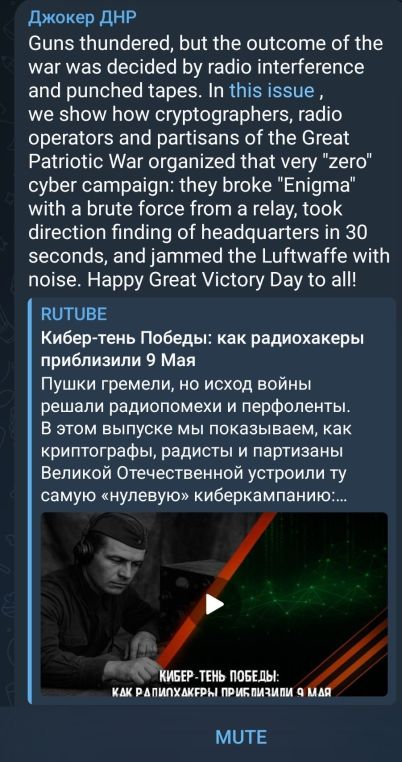
The narrative contains several deceptive elements.
First, the assertion that Soviet forces broke Enigma is historically inaccurate. The primary effort to decrypt the Enigma code was carried out by British cryptanalysts at Bletchley Park, building upon earlier breakthroughs by Polish intelligence. The USSR played no substantial role in this cryptographic achievement, and suggesting otherwise distorts the historical record. The deliberate falsehood appropriates Western scientific and military achievements and reframe them as Soviet victories.
Another misleading element is the overemphasis on punched tape and radio interference as decisive factors in the war’s outcome. While such technologies played a role in wartime communications and intelligence gathering, they were not the primary drivers of victory. The video exaggerates their impact, drawing a direct but historically unfounded connection between World War II tactics and modern cyber operations. Referring to these activities as a “нулевая киберкампания” or “zero cyber campaign” is an anachronistic invention intended to retrofit Soviet efforts into a narrative of early cyber warfare. The manufactured term has no basis in historical literature and appears to be crafted specifically to bridge past military efforts with Russia’s present-day cyber strategy.
The release of the video during Victory Day celebrations further amplifies its propagandistic impact. By invoking a day of genuine national reverence and sacrifice, the content emotionally manipulates the audience, embedding disinformation within a context of patriotic pride. The goal is to glorify past Soviet capabilities while indirectly legitimizing current Russian cyber doctrines. In doing so, it subtly positions contemporary Russian cyber operations not as acts of aggression, but as continuations of a noble legacy of technical and military excellence.
This type of content fits closely with what Treadstone 71 has described in their work on Russian influence operations and cognitive warfare. T71’s expertise shows how state actors use hybrid tactics to manipulate public perception by blending real historical events with fictional embellishments. The video is a clear example of cognitive manipulation, repackaging Soviet wartime contributions to support present-day narratives that reinforce national pride and deflect criticism of current state behavior.
The video operates is a typical piece of state-driven information warfare. It repurposes historical symbols and technologies to fabricate a narrative that positions Russia as a longstanding leader in cyber operations. Through the use of false attributions, emotional storytelling, and strategic mythmaking, the video advances a disinformation agenda designed to shape public perception both domestically and abroad.


You must be logged in to post a comment.