


Analytic Brief
Russian defense and cyber units are fusing artificial intelligence with UAV/FPV drone power optimization to harden battlefield operations, automate reconnaissance, and extend operational endurance. The document Quantum Copy of the Chronicles of ZEONA outlines detailed methodologies for calculating lithium polymer (LiPo) battery requirements, emphasizing power-to-weight efficiency, endurance extension, and load scalability. This technical foundation reveals UAV evolution into autonomous battlefield assets within Russia’s broader AI militarization strategy.
Russian military drone engineers, cyber-electronic warfare specialists, and asymmetric warfare strategists appear responsible for the guidance in the document. The anonymous ZEONA Chronicle contributors reflect embedded tactical engineers or affiliated civilian-military tech hybrid networks supporting the war effort.
The Chronicle provides an engineering framework for calculating battery specifications and energy consumption for UAVs, especially First-Person View (FPV) drones. Key concepts include:
• Nominal battery voltage based on LiPo cell count
• Maximum and operational current load during varied flight regimes
• Thrust-to-current load ratios for different payload levels
• Battery quantity calculations for mission-specific endurance
• Formulas converting thrust and electrical draw into drone power demands
Every formula is contextually grounded in tactical relevance: load-carrying, wind resistance, endurance scaling, and quick-deployment efficiency.
Precise energy budgeting gives Russian UAVs superior endurance, reliable power scaling during load changes, and optimized energy profiles in constrained logistics environments. Integrated AI systems onboard benefit from guaranteed power availability, expanding mission duration and data throughput. This optimization directly enables:
• Long-endurance surveillance under autonomous AI
• More capable FPV drone attacks with heavier payloads
• AI-guided return-to-base operations after deep incursions
• Predictive energy control during swarm operations or jamming conditions
This level of engineering readiness turns tactical UAVs into persistent AI assets capable of overwhelming EW defenses or conducting targeted strikes with minimal human oversight.
Ukraine’s escalating battlefield drone innovation—combined with Western ISR pressure—is forcing Russia to harden tactical drone deployments. Engineering superiority in flight endurance and load calibration directly supports swarm tactics, electronic warfare modules, and AI-driven battlefield autonomy. Battlefield performance no longer depends solely on flight hardware but on how deeply AI, electronics, and power systems integrate.
Russian drone formations equipped with well-calculated power schemes demonstrate increased resilience under Ukrainian EW attacks. Recovered units reveal hybrid drone designs with adaptive payload ratios, indicating field experimentation with modular AI packages. Frontline footage confirms Russian drones conducting complex maneuvers under harsh wind and terrain conditions, suggesting the success of flight regime scaling based on energy budgeting.
Russian drone strategy is entering a convergence phase—AI systems embedded into power-optimized UAVs will act as autonomous scouts, electronic jammers, and loitering munitions. As AI guidance tightens with energy scalability, swarm behavior will outmaneuver static defenses. Future drone generations are expected to:
• Self-adapt flight paths based on energy use projections
• Prioritize targets based on heat, RF, and visual cues
• Relay battlefield telemetry while conserving battery life
• Coordinate swarm attacks under low-GPS or jammed conditions
Next iterations may fuse quantum-resistant communications with real-time energy balancing, enabling networked drone intelligence with logistical autonomy.
TARGETS
The optimized energy model primarily supports:
• FPV kamikaze drones
• AI-enhanced ISR UAVs
• Swarming reconnaissance bots
• Jamming-capable airborne EW drones
• Autonomous loitering ordnance with variable payloads
MOTIVATIONS
Russian defense strategy prioritizes asymmetric parity through UAV-AI convergence. Denial of airspace, battlefield surveillance under GPS-degraded conditions, and prolonged harassment operations all require extended flight autonomy. By perfecting energy use at the engineering level, Russian systems gain strategic breathing room under increasingly congested and contested environments.
STRENGTHS
• Engineering precision allows predictable drone performance
• Scalable to various UAV forms and battlefield roles
• AI-compatible with future upgrades
• Reduces dependency on advanced Western components
WEAKNESSES
• LiPo battery reliance poses chemical volatility risks
• Supply chain disruption can cripple replacement rates
• Requires accurate field calibration; errors shorten flight or reduce power margins
• Cannot compete long-term with AI-optimized solid-state or fuel cell alternatives from NATO or Chinese sources
VULNERABILITIES
• Predictable battery configurations expose RF/electromagnetic signatures
• Standardized energy profiles enable counter-UAV spoofing
• Excess payload in undercharged units leads to crash-prone missions
• Hardened drone airframes cannot compensate for flawed energy calculations
AREAS OF EXPLOITATION
• Intercept and jam drone telemetry during low-energy return paths
• Inject false wind/load telemetry to sabotage AI-calculated power scaling
• Map standardized battery draw patterns to pre-emptively down UAVs mid-flight
• Develop AI decoys that mimic drone battery profiles to bait swarm confusion
Targeting the supply chains enabling Russian UAV energy optimization and AI-integration demands a multifaceted disruption strategy that prioritizes embedded component interdiction, dual-use technology denial, and tactical economic sabotage. Precision strikes—economic and cyber—must focus on the flow of lithium polymer (LiPo) cells, electronic speed controllers (ESCs), and high-efficiency brushless motors, which are often sourced via rebranded exports from third-party intermediaries in China, Central Asia, or sanctioned-defiant entities in the Middle East. Custom firmware updates and diagnostic tools embedded at the manufacturing or distribution level provide an avenue for post-export sabotage, enabling delayed failure under combat stress conditions. Strategic deception operations can poison technical documentation in hacker-affiliated drone engineering channels to induce systematic calculation errors that result in mid-mission power loss or catastrophic failure. Disruption of academic and commercial partnerships where Russian engineers test AI-battery integration models—particularly within pseudo-civilian research centers—should be prioritized through diplomatic pressure and targeted cyber intrusion. Counter-swarm deception and RF jamming operations should exploit power draw predictability, baiting drones into rapid discharge profiles that trigger system overloads. Denial of access to advanced battery management systems and AI-driven voltage regulators remains essential to stalling Russia’s transition from semi-autonomous drones to fully adaptive AI-powered flight units.
Table 1 Drone power methodology
quantum
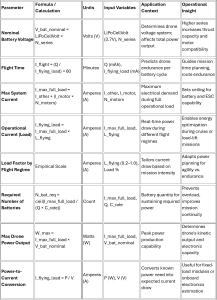
Each entry in this table supports a layered power optimization strategy that enables modularity, adaptability, and resilience in Russian UAV deployments. Let me know if you would like this exported as a spreadsheet or embedded into a larger report.
The drone power methodology outlined in the ZEONA Chronicle reflects more than raw engineering—it marks the groundwork for modular, AI-integrated airborne systems poised for long-endurance operations. Russia’s pursuit of battlefield automation now leans on electrical certainty as much as algorithmic superiority. Precision, not brute force, is now the new threshold of dominance in drone warfare.
You must be logged in to post a comment.